|
Norfolk Southern achieved higher levels of performance
throughout the organization in 2003.
Refinements to the operating plan and new performance
measurement tools helped the company produce more consistent and
reliable transportation service and provide higher value to customers.
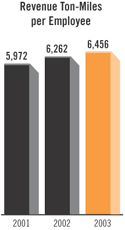
Asset and work force productivity were enhanced
through the development of more cost-effective ways of doing business.
The collective efforts of many initiatives paid
off in revenue growth and better returns for shareholders. NS
strengthened its network for supporting new business growth anticipated
as a result of improved service and a more robust economy.
NS received its 14th consecutive E.H. Harriman
Gold Medal Award, continuing its leadership in employee safety
among the nation’s largest railroads.
The company continued its support of employee
reservists called up for active duty in the armed forces. Beginning
with the activation of reservists for Operation Enduring Freedom
in 2001, NS has offered enhanced benefits designed to help employees
and their families during the deployments. The leave benefits
include a monthly income supplement and continued health care
and life insurance coverage.

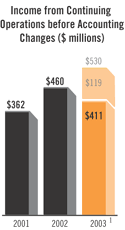
 NS posted revenues $198 million higher than in 2002.
Net income increased by $75 million or 16 percent.
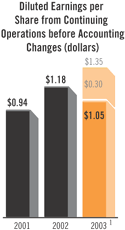
Earnings per share increased by 16 percent.
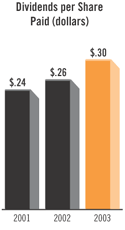
For the second consecutive year, NS increased the quarterly dividend
on its common stock, from 7 cents to 8 cents in July.
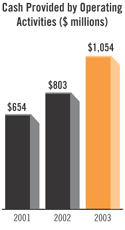
Cash provided by operating activities increased by $251 million
more than in 2002.
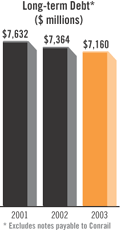
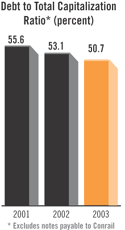
NS has reduced long-term debt by $693 million since the beginning
of 2001. NS’ share of Conrail’s long-term debt has declined
$103 million. The total three-year reduction in debt obligations
is $796 million.
NS credit ratings are among the best in the industry, reflecting
the company’s emphasis on solid financial performance.
NS’ fuel hedging program in 2003 lowered the company’s
average price per gallon of fuel. Favorable hedge settlements
reduced expenses by $59 million for the year. Hedging helps to
reduce the volatility in the price of diesel fuel and protects
the company and investors from the impact of erratic price swings
in the fuel market. At year-end 2003, NS had 63 percent of projected
2004 fuel consumption hedged at an average price of 78 cents per
gallon.
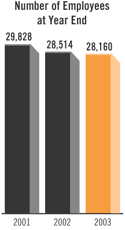
As part of an effort to address costs, the company initiated
a voluntary separation program for nonunion employees. In total,
553 employees were approved for separation, of which 314 also
were eligible to retire under the company’s retirement plan.
NS recorded a $66 million after-tax charge against fourth-quarter
earnings related to the program.

New and enhanced tools added to the company’s abilities
to measure service performance and to make quick adjustments to
network operations when necessary. Field personnel were equipped
with improved real-time information, helping them to make informed
decisions about service and to master performance of their own
operations.
The company’s Thoroughbred Operating Plan, the foundation
for NS’ transportation network, drove greater consistency
for merchandise traffic movements. NS’ Coal Transportation
Management System — a commodity transportation management
system that now includes grain traffic information — and
the Strategic Intermodal Management System also provided support
for improved network operations.
Further driving productivity and efficiency, NS continued use
of remote control locomotive technology in switching operations.
Rail freight transportation essentially comprises three operations:
customer pickup and delivery, running the trains, and making the
right connections at intermediate yards between origin and destination.
NS rolled out new systems in the second quarter of 2003 that enhance
the measurement and management of these components in detail.
The systems pinpoint performance on a car-level basis, helping
to improve consistency and reliability of service for customers.
Customer pickup and delivery is a function of moving a
rail car between a customer’s facility and a local yard at
origin and destination. NS created a system called Local Operating
Plan Adherence to help manage this transportation segment. The
system measures the amount of local switching work actually performed
against the work scheduled in a 24-hour period. Field personnel
can drill down to identify service issues by region, division,
terminal, serving yard, customer or industry route. NS’ local
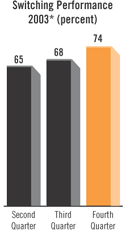
switching performance improved from 65 percent in the second quarter,
when the system was introduced, to 74 percent in the fourth quarter.
Running the trains from origin to destination is measured
best by on-time performance. Running trains according to the operating
schedule results in dependable, consistent customer service. NS
is implementing a set of tools in its Operating Plan Adherence
system to help manage compliance with the Thoroughbred Operating
Plan for individual shipments moving over the road from origination
to destination yards. The tools measure actual versus scheduled
times of arrival and permit better analysis of system operations.
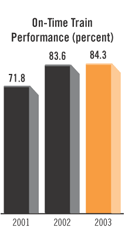
Overall on-time train performance improved to 84.3 percent in
2003.
Making the right connections is essential for efficient,
on-time transportation operations. The Operating Plan Adherence
tools provide for measurements of train blocking and terminal
connections. The measurement data are supported by NS’ Thoroughbred
Yard Enterprise System, newly enhanced as a real-time railroad
management tool. TYES now highlights cars that must make a connection
on the next train, cars in jeopardy of missing connections, and
cars running late. Blocking plans and car trip plans are compared
to actual results to ensure that the right cars are in the right
blocks on the right trains. Operating Plan Adherence began at
11 rail yards in the second quarter and was integrated at more
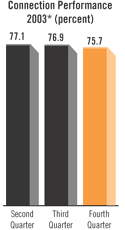
than 70 yards in the fourth quarter. In that time, total connection
performance held steady around 75 percent, with major emphasis
for improvement focused in 2004.
In addition to the benefits in operational efficiency and customer
service, these new and enhanced systems and other efforts in 2003
also led to improvements in asset utilization.
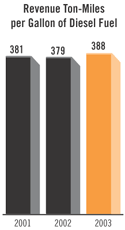
Locomotive fuel consumption was reduced by three-fourths of a
gallon per carload, saving more than 5 million gallons.
Better asset utilization led to a reduction of more than 5,000
freight cars from the fleet.
Freight car utilization improved 2 percent.
Locomotive use efficiency increased 2 percent.

Gains in operating efficiency mean better service. NS achieved
a record number of consecutive days without a service failure
for customer United Parcel Service, including a perfect fall peak
season. The error-free service streak exceeded 100 days, continuing
into 2004.
Here are some customer service awards NS received during 2003.
Coors Brewing Company named NS Transportation Supplier of the
Year.
Toyota presented NS two Logistics Excellence Awards for on-time
performance and quality performance.
Schneider National presented its Partners in Quality Award to
NS for achievements in service, innovation, continuous improvement
and ease of doing business.
Eaglebrook Inc. named NS Carrier of the Year.
Hershey Corp. presented its Galaxy Award to local NS crews serving
Hershey facilities.
The American Chemistry Council recognized NS with its National
Achievement Award for outstanding support of TRANSCAER, a chemical
safety awareness program.
Logistics Management magazine cited Triple Crown Services Company,
an NS affiliate, as Best Intermodal Service Provider for the third
consecutive year.

The payoff for improvements in operating performance and service
is better business results. Overall for 2003, revenue increased
$198 million on 2 percent more carloads than in 2002. Service
improvements and marketing efforts led to significant conversion
of both intermodal and merchandise traffic from the highways to
the rails. Value-based pricing contributed to a 1 percent increase
in average revenue per unit.
NS’ industrial development activity resulted in the location
of 69 new industries and expansion of another 20 in 2003. This
represents investment of $1.5 billion by NS customers and creates
an estimated 7,200 jobs in 17 states. NS expects this activity
eventually to generate more than 85,000 carloads annually.

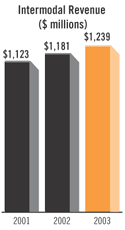
Intermodal traffic grew 5 percent to a record volume. Revenue
increased by 5 percent over 2002.
The truckload segment led the growth with a 14 percent increase,
more than half of which was highway-to-rail conversions.
NS opened its first local guaranteed service lane between Chicago
and the Northeast.
Interline guaranteed service lanes were increased from nine to
15.
International traffic grew by 9 percent.

Overall, merchandise revenues increased by 2 percent in 2003,
and carloads increased by 1 percent. Revenue per car increased
by 1 percent.
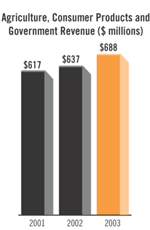
Agriculture, Consumer Products and Government posted an
8 percent revenue growth on a 7 percent increase in carloads.
Revenue and carloads both were record highs. Corn shipments set
a volume record, resulting in an 8 percent revenue increase. Reopening
of a PCS facility at Occidental, Fla., brought back phosphate
shipments, generating an increase of 11 percent in fertilizer
revenue. Shipments of military equipment increased by 36 percent.
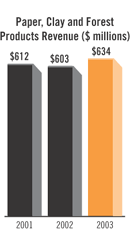
Paper, Clay and Forest Products revenue was up by 5 percent,
and carloads increased by 1 percent. Pulpboard, woodchips and
printing paper markets benefited from improved paper market conditions
and motor carrier conversions. Partnerships with other carriers
enabled NS to extend storage, rail and truck delivery services
for paper, lumber and other wood products.
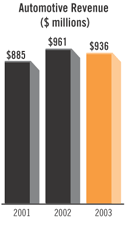
Automotive revenue and carloads decreased by 3 percent
due principally to reduced vehicle production and numerous model
changeovers at NS-served plants. During 2003, NS began direct
rail service to a new Honda plant at Lincoln, Ala. NS teamed with
Union Pacific to create the de Mex AutoFlyer, which reduced transit
schedules by two days for auto parts shipments from the Midwest
to Mexico.
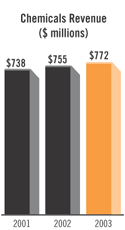
Chemicals revenue increased by 2 percent on 1 percent more
carloads. Motor carrier diversions, higher plastics shipments
and increased industrial chemical volume contributed to 2003 results.
Plastics carloads increased by 2 percent for the year.
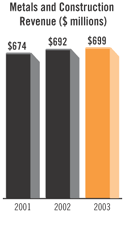
Metals and Construction revenue was up 1 percent on 1 percent
fewer carloads. Sheet steel revenue was up by 3 percent, scrap
metal revenue increased by 11 percent, and cement revenue was
up by 6 percent. A new Steelnet distribution facility expanded
market reach. Highway conversions helped offset lower volumes
in import slab steel.

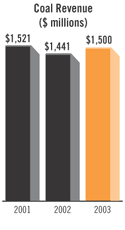
Overall, coal revenue increased by 4 percent in 2003 on slightly
more carloads.
A new Coal Transportation Management System improved trip and
car planning. The system allows NS to move loads and empties quicker,
generating faster load-to-load cycles, which improves customer
service and reduces investment in hopper cars.
Export coal through NS’ Lamberts Point transload facility
at Norfolk was up by about 2 million tons. Increased demand from
Europe developed during the year and continued in first-quarter
2004.
Utility shipments increased in the North and decreased in the
South, where reduced electricity generation was a result of mild
weather and installation of clean coal technology devices.
Industrial coal traffic was flat with 2002 levels, while the domestic
metallurgical coal market was down due to a decline in integrated
steel production.
|